By Steven Bullcoming Haworth
Truth in Focus | October 3, 2026
A Northern Cheyenne Tribal Council resolution adopted more than three years ago is raising new questions about public access to Council meetings — and about what, if anything, the resolution means for later actions taken while members of the public were excluded from in-person attendance.
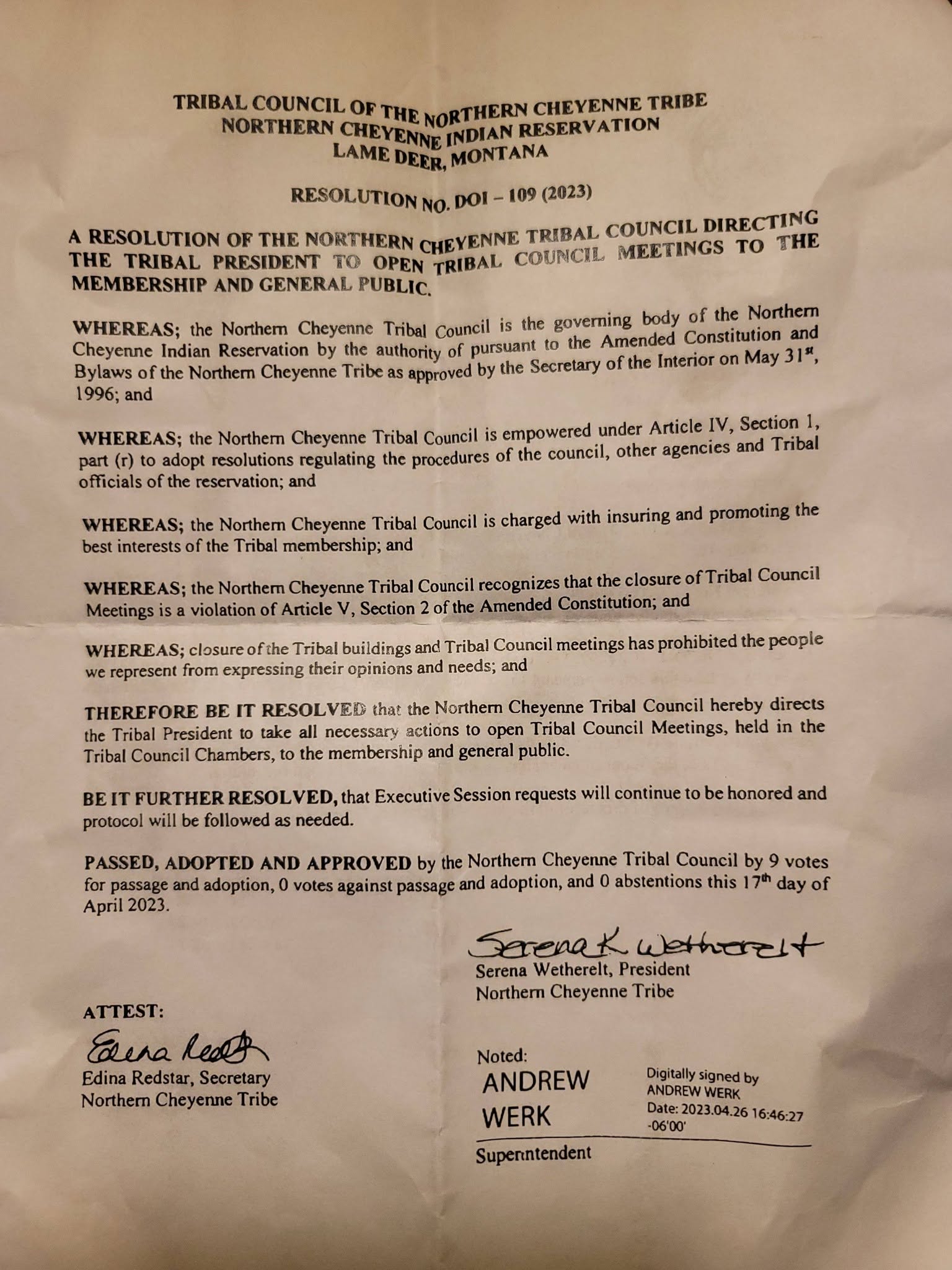
Resolution DOI-109 (2023) was adopted April 17, 2023. Its title states that the Northern Cheyenne Tribal Council was directing the Tribal President to open Tribal Council meetings to the membership and general public. The resolution records a vote of 9 in favor, 0 opposed and 0 abstaining.
The Council’s own finding
DOI-109 says the Tribal Council recognized that closure of Tribal Council meetings violated Article V, Section 2 of the Amended Constitution. It also says that closure of tribal buildings and Council meetings had prevented the people represented by the Council from expressing their opinions and needs.
The operative language directs the Tribal President to take necessary action to open Tribal Council meetings held in the Tribal Council Chambers to the membership and general public. The same resolution expressly preserves executive-session requests and says applicable protocol may continue to be followed when needed.
That distinction matters: the document does not say every subject must be discussed publicly. It establishes public access while preserving executive sessions.
BIA acknowledged the resolution
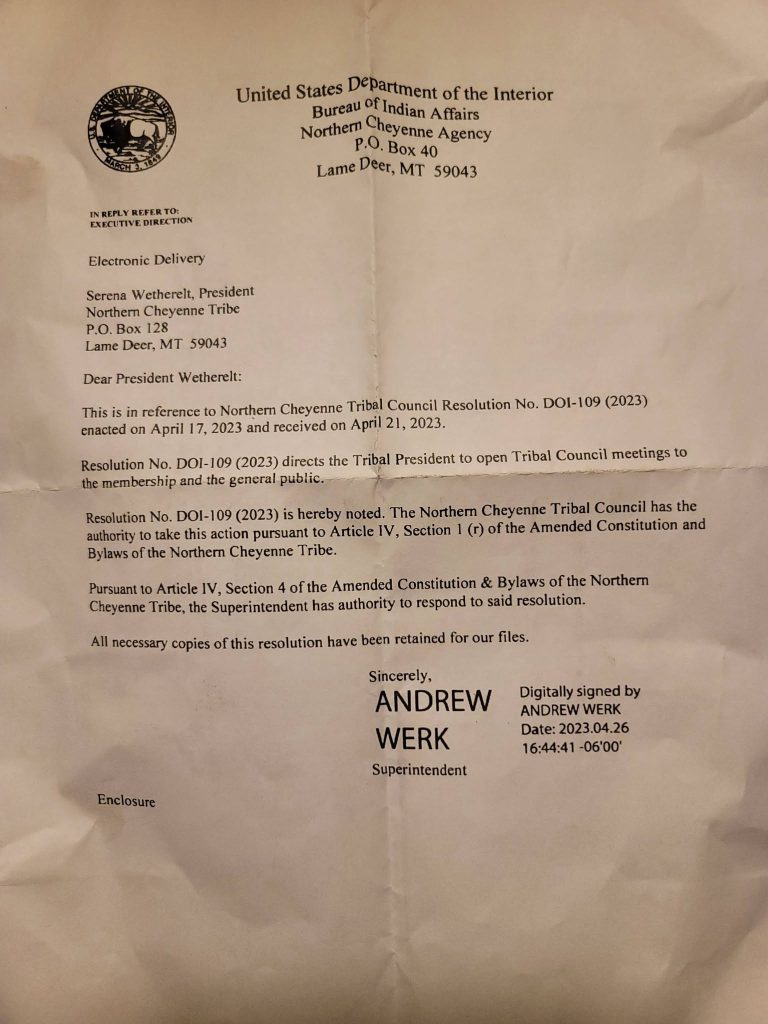
On April 26, 2023, Northern Cheyenne Agency Superintendent Andrew Werk sent then-President Serena Wetherelt a letter concerning DOI-109. The letter states that the resolution had been enacted April 17 and received by the agency April 21. It summarizes the resolution as directing the Tribal President to open Council meetings to the membership and general public.
Werk’s letter states that DOI-109 was “hereby noted” and says the Tribal Council had authority to take the action under Article IV, Section 1(r) of the amended Northern Cheyenne Constitution and Bylaws.
Document image provided by Waylon Rogers via a public Facebook post.
Then the meetings closed again
Montana Free Press reported that, following a physical altercation during an Aug. 18, 2025 Council meeting, the Council announced Aug. 25 that future meetings would be closed to in-person attendance but available on YouTube. MTFP also reported community criticism of the closure and calls for transparency.
Source: https://montanafreepress.org/2025/09/12/the-dispute-between-the-northern-cheyenne-tribal-council-and-its-president/
Was DOI-109 ever repealed?
Truth in Focus has not yet located a subsequent resolution expressly rescinding, repealing, suspending or superseding DOI-109.
That is not the same as saying no such record exists. Public online archives are not necessarily complete, and a later resolution, ordinance, court decision or other governing record may exist outside the materials reviewed so far.
The question is therefore straightforward: If DOI-109 remained in effect, when — and by what authority — did the public-access rule change?
Another unresolved question: where was the public supposed to go?
The location of later proceedings raises a separate access issue.
Buffalo’s Fire reported that the Sept. 30, 2026 removal hearing was scheduled for the Little Wolf Capitol Building and that disputes over public access occurred there. The publication later reported that an afternoon Facebook livestream began, but its report did not identify the physical location of those later proceedings.
Source: https://www.buffalosfire.com/northern-cheyenne-tensions-mount-as-ousted-council-seeks-presidents-removal
Community members have told Truth in Focus that some later proceedings occurred on privately controlled property and that the private setting affected whether people felt they could physically approach or attend. Truth in Focus has not independently verified the exact location, ownership, parcel status or jurisdiction of that property and is not publishing a private address.
The land-status distinction matters, but it must be described carefully. The Bureau of Indian Affairs distinguishes trust land, restricted fee land and fee-simple land. Fee-simple land is generally controlled by the titleholder; trust land is held by the United States for a tribe or individual Indian; and restricted fee land is owned by an individual Indian or tribe but remains subject to federal restrictions on transfer or encumbrance.
Source: https://www.bia.gov/bia/ots/fee-to-trust
A privately owned parcel may exist within reservation boundaries, and land status can affect taxation and jurisdiction. That does not, by itself, establish that a meeting held on private property was lawful or unlawful under Northern Cheyenne law.
The public-access question is narrower: If an official Tribal Council meeting is moved to a place where members of the public cannot physically enter, does that satisfy DOI-109 or any other controlling meeting rule? Truth in Focus has not found an authoritative answer to that question yet.
Does DOI-109 invalidate later Council actions?
This is now a significant legal question, but DOI-109 alone does not establish that every later action taken during a closed meeting is automatically void.
Several questions would need to be answered first: Was DOI-109 still legally effective at the time? Does its reference to meetings held in the Tribal Council Chambers limit its application? Does livestreaming satisfy the requirement that a meeting be “open” to the membership and general public? And what remedy does Northern Cheyenne law provide if a Council meeting violates a procedural resolution?
Until those questions are answered by the controlling law, records or courts, Truth in Focus will not characterize later Council actions as automatically invalid.
Record Room: View the DOI-109 archive entry and related source notes →
Additional hearing context under review
Readers have raised a separate question about earlier proceedings in the broader leadership dispute, including an account that President Gene Small offered another hearing and that some participants left that proceeding. Truth in Focus has not yet located the notice, minutes, complete video, transcript, participant record or other primary documentation needed to independently establish exactly what occurred.
That history may be relevant to the broader dispute, but it does not by itself answer the narrower question examined here: what Resolution DOI-109 required concerning public access to Tribal Council meetings, whether it remained in effect, and how it applied to later proceedings. We are continuing to seek the underlying records and will update this reporting when the documentary record supports doing so.
This updates our earlier reporting
In earlier research, Truth in Focus reported that the records then available to us did not establish a simple open-meeting requirement. At that time, DOI-109 was not among the documents we had located.
It is now.
That materially changes the documentary record we have available. Good reporting requires updating conclusions when better evidence is found.
Truth in Focus is continuing to search for any later resolution, ordinance, court ruling or other official record that amended, suspended, repealed or otherwise changed DOI-109.
If such a record exists, we will report it.
Document images provided by Waylon Rogers via a public Facebook post.
#TruthInFocus #NorthernCheyenne #TribalGovernment #OpenMeetings #PublicRecords #Transparency #MontanaNews #PublicAccountability